AI Trading Assistants for Crypto: Complete Guide to Automated Trading 2026
How AI trading assistants work for crypto, their benefits and risks, and why they're changing the game. Learn about Get Agent and the future of AI-powered trading.

AI Trading Assistants for Crypto: The Complete Guide to Automated Trading in 2026
Once upon a time, people spent years learning technical analysis to trade successfully. Today, dozens of AI tools can trade for you and potentially earn solid passive income.
I’m diving into AI trading assistants today, including how they differ from traditional trading bots, the benefits and risks you need to know, and what the future holds for this promising technology.
Disclaimer: I’m not a financial advisor, and nothing in this article constitutes financial advice. This is educational content meant to inform you about AI tools for crypto trading.
Trading Bots vs. AI Trading Assistants: What’s the Difference?
Understanding the distinction between regular trading bots and AI trading assistants is crucial for making informed decisions about which tools to use.
A normal trading bot is like a vending machine. You input a set of rules—price bands, time intervals, order sizes—and the bot trades exactly as instructed. You set the logic, and the bot operates within those exact parameters. These have existed long before the current AI trading hype.
AI trading assistants, often called AI agents, take things to another level. Instead of coding your strategy into a rigid template, you simply describe your goal in plain English. The agent interprets your intent and helps you, whether that’s with market research or executing a trading strategy you just explained.
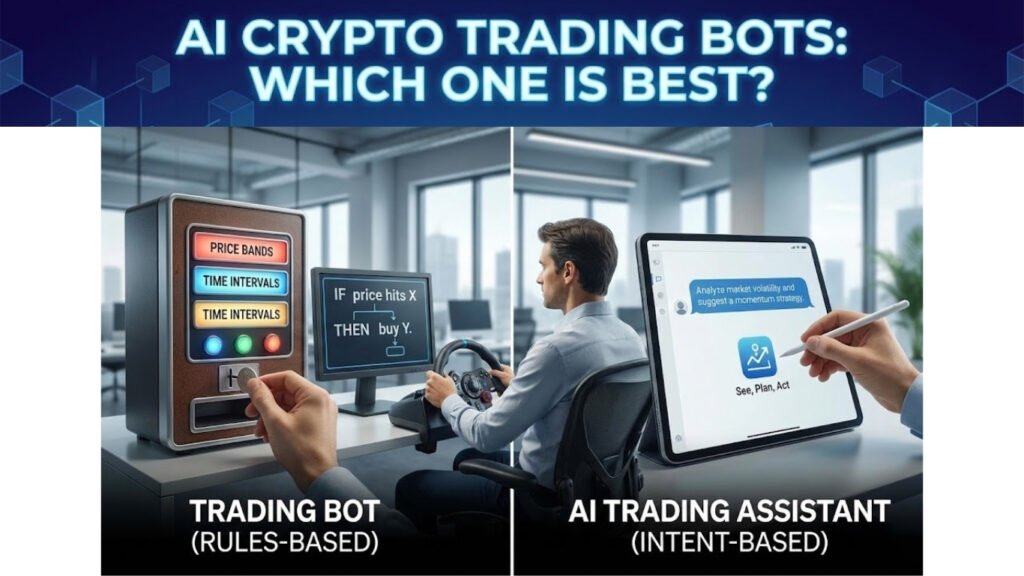
In other words, AI assistants can help you formulate an investment plan or trading strategy and only execute actions when appropriate. AI assistants follow a path of “see, plan, act” compared to the simple “if X, then do Y” logic of trading bots.
However, this doesn’t make AI trading assistants all-knowing oracles. Far from it. But they do bridge the gap between research and execution in a way that feels more human. Ready to put theory into practice? Start with Best Crypto AI Trading Bots of 2026 and build from a safe foundation.
What AI Assistants Can Do
AI assistants can help you figure out how to accomplish specific tasks, whether that’s bridging to an obscure niche blockchain or determining the best way to sell a low-liquidity token. They’ll compare tactics, summarize trade-offs, and outline risks in a couple of sentences so you can decide whether to proceed.
Although technically different, there’s overlap between regular bots and AI agents. Generally speaking, both can help execute trades and trading strategies. However, the clearest split appears during market volatility.
A range bot that worked in a sideways market might get punished when volatility hits. In contrast, an AI assistant paying attention to regime shifts can say, “Hey, your grid idea is fighting a trend. Do you want to switch to a momentum strategy instead?” An AI agent’s main value lies in pivots like that.
Human Control Remains Essential
Just to be clear: AI assistant doesn’t automatically mean fully autonomous. Most AI assistants keep you, the human, involved in each step by design. This could be a list of steps you must review and confirm before your agent can proceed.
You still set the boundaries and approve what gets sent to the order books. After all, you don’t want your AI assistant risking your entire account balance without explicit approval. You want to remain firmly in the driver’s seat while the software makes things run smoother.
AI agents represent a significant step above most trading bots in terms of capabilities. The trend is clear across the industry—chat-first AI assistance is becoming the norm, and more traders are using these tools.
BitGet Agent: AI Trading in Action
A great example is Get Agent, an AI agent built directly into the BitGet exchange. Get Agent lives inside the BitGet app and behaves like a chatty co-pilot. You type what you want to do, it provides an answer or proposes a plan, and if you agree, it can line up a task or trade for your approval.
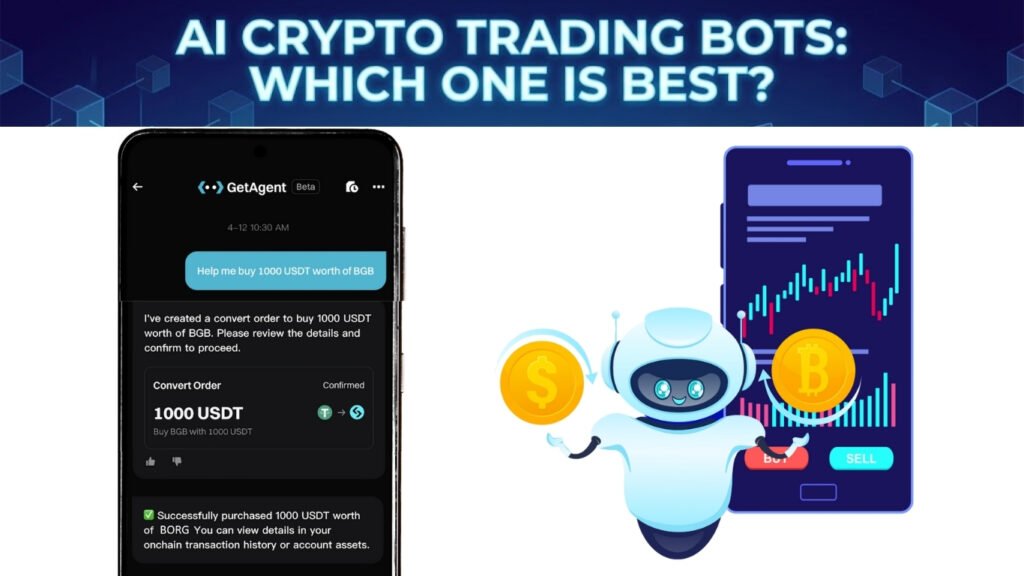
Accessing Get Agent is simple. You can find it in the more services menu, but you’ll also see banners for Get Agent in the assets tab, spot pages, futures pages, and so on. It’s neatly integrated into the flows you’re already using.
Practical Examples of Get Agent
Once you open the chat, it’s plain English from there. For spot trading, if you ask Get Agent to “help me buy 1,000 USDT worth of BGB,” the agent drafts an order card with the size and pair pre-filled, shows you the preview, and waits for your approval. You’re still in control of the final trigger.
What about trading something more exotic? Let’s say you want to buy a token via BitGet’s onchain routes—something not listed on BitGet’s spot order books. You can simply tell the agent, “Help me buy 1,000 USDT worth of Borg.” It then builds a route aimed at the best available price and returns an onchain order preview with key details.
But Get Agent goes beyond speeding up standard tasks. You can use it for market research and strategy development. Type something like “comprehensive analysis of BTC,” and Get Agent will put together an analysis of Bitcoin’s recent price action. From there, you can push the agent for as much information as you wish, just like having your own research assistant.
Get Agent can combine its research capabilities within the context of your specific portfolio and build a plan that makes sense as your portfolio and markets develop. That dynamic, practical assistance is the key difference from simple trading bots.
Just remember: you’re still in control, and AI agents can make suboptimal suggestions from time to time. It’s still up to you to do your own research and double-check the output. Think of Get Agent’s output as a first draft—you’re the one who makes the final edit and decision.
Pro tip: Start any AI-driven trading strategy with small size, double-check every preview, and stick with spot markets if you’re still getting your bearings. The main focus should be enhanced efficiency.
5 Major Benefits of AI Trading Assistants
AI agents offer clear advantages for crypto traders. Here are five big pros to consider:
1. 24/7 Market Coverage
Just like crypto, AI agents never sleep. When markets run 24/7, the edge often goes to whoever can scan and act quickest. AI lets you cover more markets, pairs, and shifts than your human brain can juggle at 2 AM on a Monday.
2. Massive Time Savings
Instead of scrolling through 10 tabs to figure out why a token just dumped, you can ask an assistant and get a neat summary. It could take hours to do all the research and analysis an AI agent can complete in seconds. All you have to do is ask for help.
Some assistants aren’t even waiting for you to ask anymore—they’re shifting toward proactive, personalized updates that help maintain your market edge.
3. Emotional Control
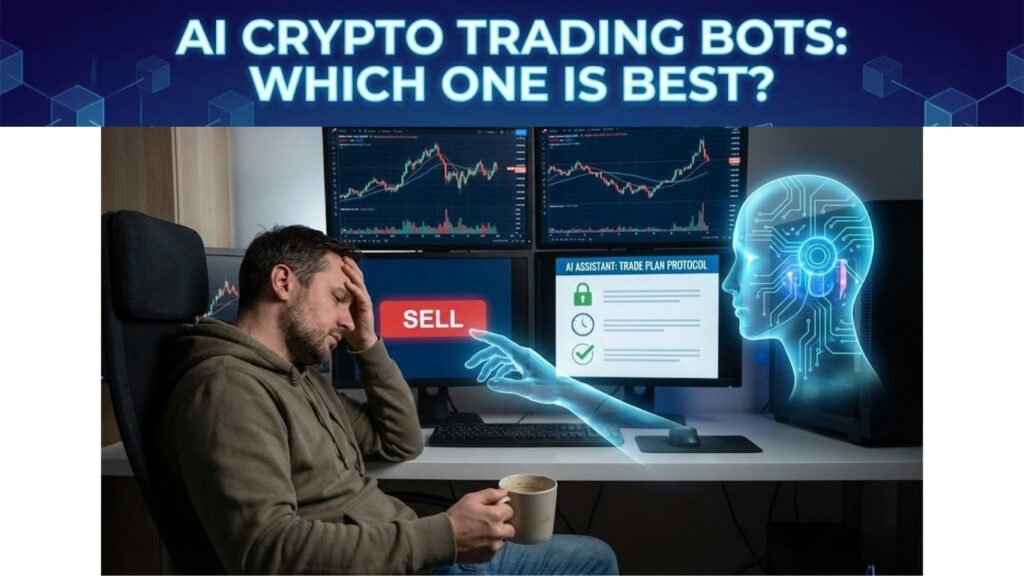
Most of us are terrific at inventing reasons to ignore our plan—forcing trades with bad entries, revenge trading, FOMOing, or YOLOing. Using an AI agent helps push you toward rules and away from emotions, leading to better performance over time because they mute emotion-inducing market noise.
If an AI assistant can translate your trade idea into a checklist and keep tapping your shoulder when you drift off plan, that’s tremendously valuable. Having structure helps you avoid bad impulses in markets that love to mess with your head.
4. Improved Trading Execution
Whether it’s a quick transaction on a major exchange or routing an onchain swap for something niche, software can set up and execute faster than you can manually in a 24/7 market. That speed helps a lot, and automation exists exactly for this reason.
5. Reduced Human Error
Manual trading often involves rushed decisions, mistyped orders, or simply missing opportunities due to fatigue or distraction. In fast-moving crypto markets, even small mistakes can result in significant losses or painful missed opportunities.
AI agents are machines that can execute faster and more consistently than manual clicking, giving you much better consistency in turn. By eliminating slip-ups and enforcing discipline, AI agents help reduce the frequency of costly blunders.
5 Critical Risks of AI Trading Assistants
Just because there are great advantages doesn’t mean it’s all sunshine and rainbows. Here are five risks to keep in mind:
1. AI Errors
While AI can help you avoid typical human errors, AI can also make mistakes unique to artificial intelligence. Sometimes agents speak with total confidence even when they’re clearly wrong, whether due to stale data or other model limitations.
That’s why it’s important to do final checks on any AI suggestion before proceeding.
2. Idea Crowding
This is becoming clearer as AI use becomes more widespread. Even separate, unrelated AI agents will often come up with similar strategies. When lots of people chase the same idea, you get reflexive trades that eat the edge and sometimes become straight-up exit liquidity.
Copy trading culture doesn’t help here either. Remember: if your strategy only works as long as you’re close to the front of the line, it’s more a game of chicken than a strategy.
3. Over-Reliance Dulling Your Trading Mind
In crypto, your biggest, most profitable trades will likely be those gems that run hard—reflexive trades where you sit on your hands and let crypto trend up and melt faces over weeks or months.
AI agents, however, are likely not going to tell you to sit on your hands. They’re much more conditioned to prioritize profit-taking and risk aversion. These aren’t bad things, but humans are much better at identifying great long-term holds or new trends, especially in crypto where markets can move based on inputs AI hasn’t fully grasped yet.
Don’t be afraid to trust the instincts you’ve developed over years of practical experience. AI doesn’t have an edge on humans there—at least for now.
4. Over-Complicating Crypto Trading
Yes, AI lets you spin up complex trade structures much faster, but that’s only good right up until it isn’t. An AI agent may lead you to implement something like an advanced futures trading strategy involving leverage.
Tacking on 10x leverage means small errors can get amplified into spectacular liquidations if you’re not careful. Just because you’re using AI tools doesn’t mean you’re invincible. AI assistance can help you execute trading much faster, but it can also help you liquidate yourself much faster if you don’t fully understand what you’re doing.
5. Technical and Security Risks
Outages or coding bugs can disrupt an AI agent’s execution, either resulting in you losing out on good trades or possibly amplifying trading losses.
Deeper security risks come with advanced AI tools that connect to exchanges through third-party APIs, which essentially act as bridges for executing trades. This risk isn’t unique to AI—ThreeCommas, a crypto trading service, gave traders a harsh lesson when its API keys surfaced online and users reported unauthorized trades that drained accounts.
I’m not mentioning these risks to discourage you from using AI tools. They’re just a reminder to be careful with this technology, as you should be with anything related to trading.
Is AI Trading Worth It?
On balance, I believe the answer is yes. If you’re trading without AI at this point, you’re playing short-handed. It won’t turn you into a wizard, but it can improve anyone’s trading decisions.
If other traders are using these tools and you aren’t, they’re simply playing the game more efficiently than you are. That doesn’t mean you can’t be profitable without AI, but it means you’re leaving extra efficiency on the table. And efficiency compounds the same way that bad habits do.
The Future of AI Trading
What does the future hold for this promising niche? Agents will likely start handling more capital natively. We’re talking AI software that can authorize, authenticate, and settle ever more complicated transactions on your behalf, albeit under strict permissions.
In the same vein, we’ll likely start seeing more agents become proper onchain users via the DeFi AI sector. The more advanced AI agents get, the better they’ll be at trading and investing.
It may sound like science fiction, but it’s really just an advancement on bots already executing profitable strategies onchain as we speak. However, things may get weirder. We may reach a stage where agents aren’t just clicking buttons on our behalf, but negotiating, coordinating, and transacting with each other as semi-independent economic actors.
That’s already in the works, but we have yet to see advanced forms that would actually wow people. However, that day is likely coming.
But none of this erases the need for risk management and discipline. The most likely future remains trusted autonomy, where you and your agent act like a good tag team rather than machines taking over. You direct things, your agent does much of the leg work, and you sign off on the big swings.
Frequently Asked Questions
Q: Can AI trading agents guarantee profits in crypto markets? A: No, AI trading agents cannot guarantee profits. While they can improve efficiency, reduce human error, and provide faster execution, they’re still subject to market volatility and can make mistakes. They’re tools to enhance your trading, not magic solutions. Always maintain proper risk management and never invest more than you can afford to lose.
Q: How much capital do I need to start using AI trading assistants? A: You can start with small amounts. The transcript specifically recommends beginning with small size when starting any AI-driven trading strategy, particularly if you’re still getting your bearings with spot markets.
Q: Are AI trading assistants fully autonomous? A: No, most AI assistants keep humans involved in each step by design. You review and confirm steps before the agent proceeds. You set boundaries and approve what gets sent to order books, maintaining control while the software makes things run smoother.
Conclusion
AI trading assistants represent a significant evolution in how we approach crypto trading. They bridge the gap between research and execution, offering 24/7 coverage, time savings, emotional control, improved execution, and reduced errors.
However, they also carry risks including AI errors, idea crowding, over-reliance, over-complication, and security concerns. The key is using these tools as assistants rather than replacements for human judgment and discipline.
The practical move is simple: start using these tools now. Not because of FOMO, but because AI agents simply help. As the next generation of AI tools arrives, being well-practiced with these first iterations will position you to get the most out of future advancements. These tools are only going to get better, and familiarity with the technology will be essential.